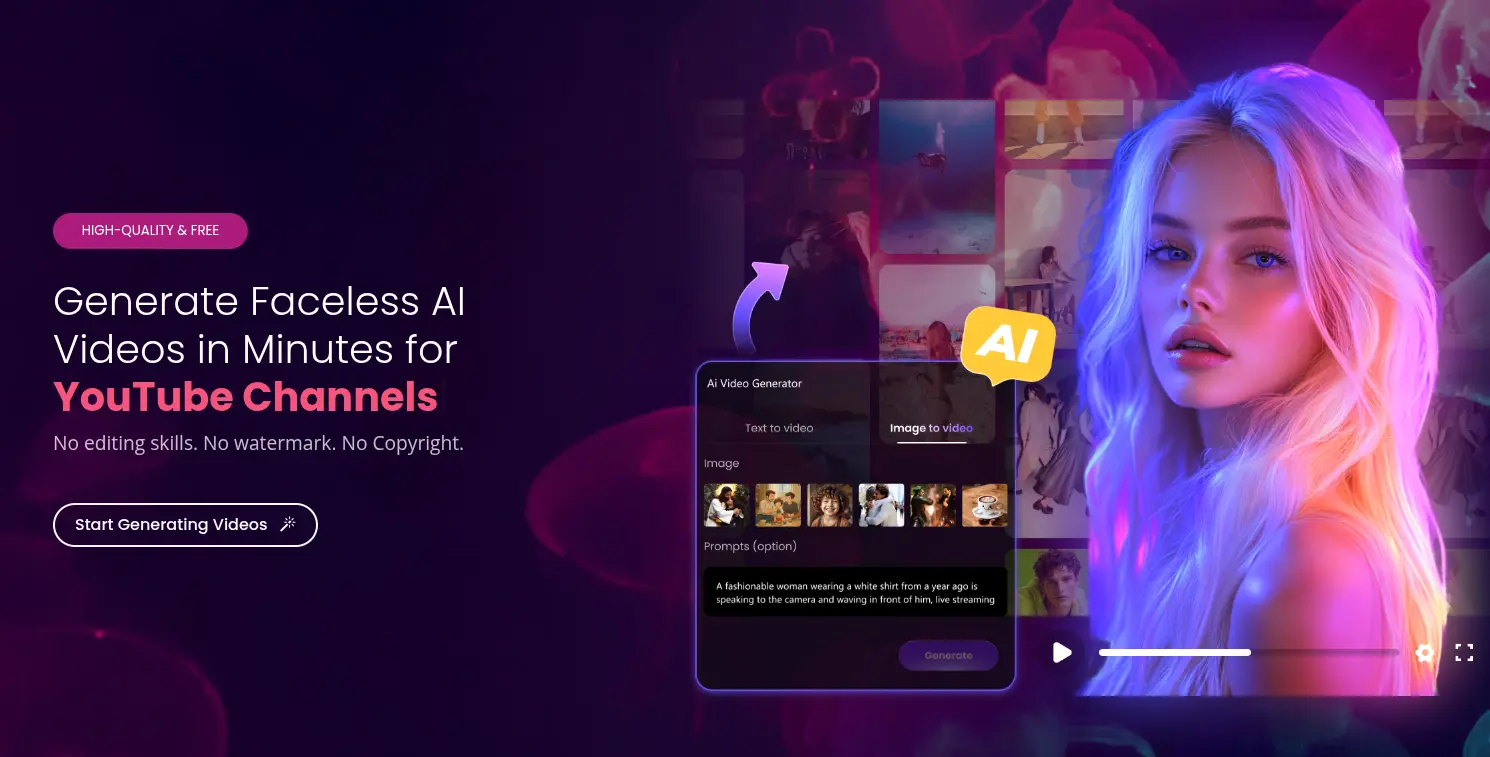
Alright, it’s amazing how few people are aware of this, but some people have been using a completely free video maker to blow up their YouTube channels and TikTok accounts.
If you’ve spent any time creating content online, you already know how frustrating it can be. You post regularly. You try new ideas. You even improve your editing. Yet somehow, your videos barely move. Meanwhile, someone else uploads something simpler and suddenly gains thousands of views overnight. It feels unfair, confusing, and honestly discouraging.

The problem isn’t that you’re not working hard enough. It’s that the internet doesn’t reward effort the way we were taught it would.
The Internet Doesn’t Reward Hard Work, It Rewards Value
This is one of the hardest truths to accept as a creator. Platforms like YouTube and TikTok don’t measure how long you spent editing, scripting, or planning. They measure how viewers react. Do people stay? Do they watch to the end? Do they engage, rewatch, or share?
You can pour hours into a video that looks great but says very little, and the algorithm will quietly ignore it. At the same time, a simple video that clearly explains an idea or tells a short story can outperform it within hours. The system isn’t judging your content, it just doesn’t care about effort without value.
This is why so many creators feel stuck. They’re working hard, but the output isn’t aligned with how people consume content today. When hard work is applied to the wrong format, it turns into wasted energy.
Why Most Videos Barely Get Views
Most low-performing videos fail for one simple reason: they don’t give viewers a reason to stay.
Scrolling platforms are brutal. You have seconds to make someone care. If the video lacks structure, direction, or emotional pull, people leave. When they leave early, the platform is aware and stops pushing it. This is because competition for attention is intense and these scrolling-platform are never willing to sacrifice the interest of viewers for less valuable content.
Creators often focus too much on visuals and not enough on clarity. A video doesn’t need to be complex, but it does need purpose. Viewers should immediately understand what they’re watching and why it’s worth their time.
This is where storytelling quietly becomes one of the most powerful tools online.
Stories Are the Shortcut Most Creators Ignore
Stories work because they create momentum. When a video follows a clear flow, people naturally want to know what happens next. This applies to everything, not just entertainment. Explaining an event, breaking down a concept, summarizing a blog post, or walking through an idea all work better when framed as a story.
That’s why explainer videos, historical breakdowns, mini-documentaries, and narrative-style content often outperform random clips. They guide the viewer instead of dumping information on them. And platforms reward that kind of engagement.
The irony is that many creators already have stories sitting unused. Blog posts, written ideas, lessons, timelines, or experiences that never become videos because the process feels too technical or time-consuming.
The Real Problem: Turning Ideas Into Videos Consistently
This is where most growth dies. Not at the idea stage, but at execution.
Traditional video editing tools are powerful, but they’re not friendly for fast experimentation. They demand time, learning curves, and patience. For someone trying to post consistently across platforms like YouTube, TikTok, and Instagram Reels, that friction adds up quickly.
So creators delay. They overthink. Or they post inconsistently due to the hardwork required for video editing and then they wonder why growth feels random.

But the good news is, there’s a smarter approach!
A Smarter Approach to Video Creation
Tools designed around speed and clarity can dramatically change a creator’s workflow. Instead of spending hours assembling visuals manually, creators can focus on refining the message and structure. This approach is especially effective for:
- Turning blog posts into videos
- Explaining concepts or events
- Creating educational or story-driven content
- Maintaining consistency across platforms
The Tool Most People Aren’t Talking About
Near the end of my search for faster ways to turn ideas into videos, I came across Y2Boost.
Y2Boost is a free AI video maker designed around a simple idea: help creators turn value into video without unnecessary complexity. Instead of forcing you to master advanced editing, it focuses on helping users present information with clarity and effectively.
You can use it to convert blog posts into videos, tell short or long-form stories, explain events, or create content specifically optimized for social platforms. This makes it especially useful if you already write content or have ideas but struggle to publish consistently in video form.
Image placeholder: Clean interface showing a text-to-video workflow
Why Tools Like This Actually Matter
Platforms like YouTube, TikTok, and Instagram Reels are flooded with content. Standing out doesn’t mean doing more, it means communicating better.
A tool that helps you focus on delivering value clearly can save you months of trial and error. Instead of guessing what works, you can test ideas quickly, learn what holds attention, and adapt.
Y2Boost remove friction, and when friction disappears, consistency becomes easier. When consistency improves, growth becomes possible.
Final Thoughts
If your content isn’t growing, it doesn’t automatically mean you’re bad at creating. It may simply mean your ideas aren’t being delivered in a format the algorithm understands or the audience wants to consume.
Hard work still matters, but only when it’s applied in the right direction. Story-driven, value-focused videos are no longer optional. They’re the baseline.
If you already have ideas, blogs, or concepts waiting to be shared, tools like y2boost can help bridge the gap between effort and visibility. And sometimes, that bridge is all it takes for things to finally start moving.


